

My prior essay discusses two modern approaches to legal interpretation: textualism and purposivism. And it seeks to position Jesus on the interpretive map in light of Second Temple Jewish debates over text vs. tradition and strictness vs. leniency. I began to argue that Jesus’s interpretive method is most aligned with modern-day textualism.
Here I want to make that case in more detail with a focus on three legal discourses within the Gospel accounts, each to illustrate a different point: (1) Jesus as a hyper-literal (though creative) textualist, (2) Jesus as a skeptic of oral tradition, particularly where it detracts from explicit written commands, and (3) Jesus as a whole-law originalist, urging that the Law’s expressed purposes must guide and constrain interpretation.
Matthew 22:23-33: Jesus’s Hyper-Literal Proof of the Resurrection
Substantively, Matthew 22:23-33 is a debate between Jesus and the Sadducees about the resurrection of the dead. But there’s more to this passage than meets the modern eye. Recall that the Sadducees are textualists who deny the resurrection; the Pharisees are oral-traditionalists who affirm the resurrection.
In this passage, Jesus cleverly employs Sadducean-style textualism to affirm a Pharisaical tenet.
The Sadducees begin the discourse with a question about levirate marriage, the legal requirement that if a man dies, his brother must marry his widow and raise his children. The Sadducees offer a hypothetical in extremis involving seven brothers, each of whom dies after marrying the same woman (the ultimate femme fatale). The Sadducees think this leads to an absurd result: “In the resurrection, therefore, of the seven, whose wife will she be? For they all had her” (v.28). Jesus denies any absurdity because, he says, there’s no marriage in the resurrection—everyone is “like the angels” (v.30).
Okay, Jesus, fine—but how do you know there’s a resurrection at all? That’s the basic point the Sadducees are making. And Jesus has an answer:
“[A]s for the resurrection of the dead, have you not read what was said to you by God: ‘I am the God of Abraham, and the God of Isaac, and the God of Jacob’? He is not God of the dead, but of the living” (v.32).
Jesus here quotes Exodus 3:6, the burning bush scene where God reveals himself to Moses: “I am the God of your father, the God of Abraham, the God of Isaac, and the God of Jacob.” How does Jesus get from this passage to the resurrection of the dead? His logic depends upon two things.
First, the present tense of the verb: “I am the God.” By the time of Moses, the three patriarchs Abraham, Isaac, and Jacob are long dead. Yet God identifies himself as their God in the present tense—not “I was Abraham’s God,” but “I am Abraham’s God.” This implies that the patriarchs are still, in some sense, alive.
Second, the Sadducees’ own example—levirate marriage—is predicated on the idea that death ends covenantal obligations. That’s why it’s not adultery for a man to marry his sister-in-law after his brother’s death. But if God in Exodus 3 sees himself as still covenantally bound to the patriarchs, then necessarily they are not dead. They are alive, or at the very least they remain under a promise of reanimation sufficient to keep the divine covenant binding.
QED: Resurrection. This is Jesus’s argument.
He appeals not to unwritten or prophetic tradition. He makes his argument based solely on the Scriptural text. His present-tense-verb argument is literal in the extreme. His enduring-covenant argument is creative. Both are techniques the Sadducees would have recognized and appreciated. By contrast, the Pharisees probably disagreed with Jesus’s approach—why creatively stretch the text when tradition offers the answer?—but they concurred in his conclusion.
Matthew 22:23-33 is Jesus using Sadducean logic to reach a Pharisaical conclusion. He gives each side something they want—and yet denies them both something they demand.
Matthew 22:23-33 is the Marbury v. Madison of the Gospels.
American legal scholars and practitioners will appreciate the analogy. The underlying events in Marbury occur at a tense time during the presidential handoff between John Adams (a Federalist) and Thomas Jefferson (a Democratic-Republican). Glossing over many of the details, in the decision, Chief Justice John Marshall asserts the power of federal courts to overturn unconstitutional laws—i.e., the power of judicial review, something very important to the Federalists—yet he uses this logic to invalidate a Federalist law and thus deliver a political win to the new Jefferson administration. In other words, Marshall uses Federalist logic to reach a pro-Jeffersonian conclusion. He gives each side something they want and denies them something they demand.
Marbury is one of the first cases American law students study. I think Matthew 22:23-33 deserves similar primacy of place for students of the Gospels and biblical interpretation. It is the example par excellence of Jesus as a sophisticated, text-bound legal thinker who simultaneously inhabits and defies the interpretive categories of his day.
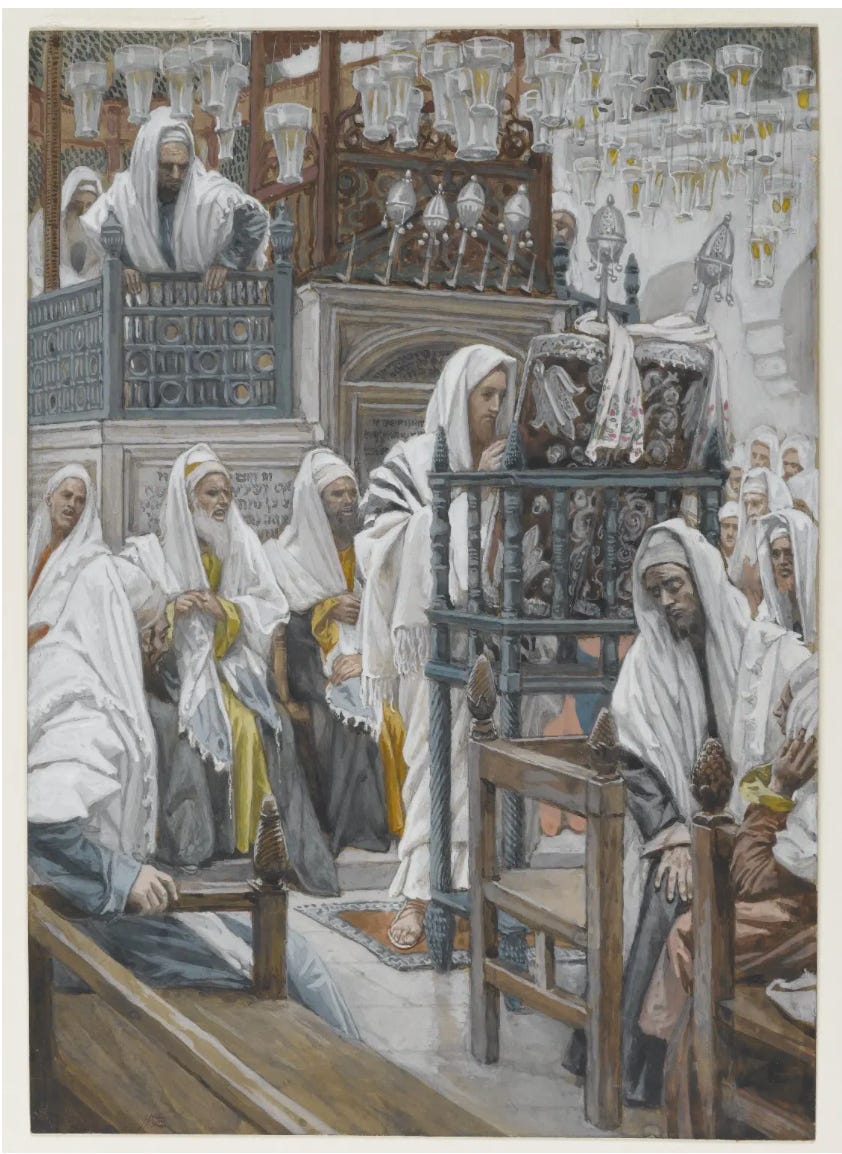
Mark 7:5-13/Matt. 15:1-9: For Jesus, Explicit Mandates Trump Oral Permissions
If Matthew 22:23-33 is an example of Jesus’s “super-textualism,” then Mark 7:5-13 (with parallel in Matt. 15:1-9) showcases his critique of oral tradition.
The legal background to Mark 7:5-13 is the making of vows, specifically in regard to Temple-gifts, whereby one could pledge some portion of his property for the support of the Temple and the Temple would later receive the property or the monetary equivalent.
These were voluntary gifts, over and above what a person was obligated to bring to or offer in the Temple. As such, they were often expressions of heartfelt worship, devotion, and gratitude toward God. For Christians, the modern-day parallel would be financial contributions to your church or, more precisely, a charitable bequest specifying that, upon your death, your property is to be sold and the proceeds donated to your church.
In principle, vowed gifts were a good and noble thing. The Bible praises Hannah for dedicating her son Samuel to God’s service (1 Sam. 1-2). Jesus praises financial generosity toward the Temple (Mark 12:41-44).
But the Torah is not flippant about vows and oaths. It treats them with utmost seriousness, particularly if a person invokes God’s name (or a euphemistic equivalent) in the making of them (see Exod. 20:7). Numbers 30 supplies the basic rule:
“If a man vows a vow to the Lord, or swears an oath to bind himself to a pledge, he shall not break his word. He shall do according to all that proceeds out of his mouth” (v.2).
There are basically no exceptions to this rule.1 In Deuteronomy 23:21-23, Moses reiterates: “If you make a vow to the LORD your God, you shall not delay fulfilling it, for the LORD your God will surely require it of you, and you will be guilty of sin.” But Moses also points out that vows are voluntary—you don’t have to make them, and “if you refrain from vowing, you will not be guilty of sin.” Both the wisdom tradition (Eccl. 5:1-7) and Jesus himself (Matt. 5:33-37) pick up this point, urging that because the Law is so strict about vows and oaths, it’s better not to make them at all.
Leviticus 27 is a limited qualification to the general rule, specifying how a Temple-gift is to be valued. If a person later decides to keep the property he has voluntarily pledged, it’s an expensive choice: he pays the equivalent value plus a 20% surcharge.
As against the Law’s stringency, the Pharisees had developed a set of oral traditions that treated vows more leniently. Among other things, they allowed a person to be released from a vow entirely—essentially voiding it—if his circumstances had materially changed in unforeseen ways. (See t. Nedarim 9.)
Such ex post leniency had ex ante effects. If people can get out of their vows too easily on the back end, they’re ready to make vows too easily on the front end. This cheapens the whole enterprise. Vows become less serious. People will invoke the divine name too flippantly. And they won’t be able to rely upon one other to keep promises, thus diminishing social trust.
This is Jesus’s basic critique in Mark 7:5-13, accusing the Pharisees of “rejecting the commandment of God in order to establish your tradition” (v.9). Jesus takes the written Law (“the commandment of God”) seriously, which means he takes vowmaking seriously. The Pharisees, by contrast, are too lenient, too liberal.
Jesus singles out one scenario for particular criticism. (Here I’m going to shift to the parallel rendering in Matthew.)
“For God commanded, ‘Honor your father and your mother,’ and, ‘Whoever reviles father or mother must surely die.’ But you [Pharisees] say, ‘If anyone tells his father or his mother, “What you would have gained from me is given to God [i.e., pledged to the Temple],” he need not honor his father.’ So for the sake of your tradition you have made void the word of God.” (Matt. 15:4-6)
Note that Jesus is not criticizing the Pharisees for refusing to let the son out of his vow. Rather, Jesus objects to the fact that the son is allowed to make this kind of vow in the first place. His target is the Pharisaical rule that permits a son to make such a parent-dishonoring vow at all. Laxity about vowmaking encourages people to make vows they can’t keep or, worse, vows that violate other biblical precepts.
The key to understanding this is Leviticus 27, the Torah’s most explicit legislation on Temple-gifts. While the first half of the chapter concerns valuation of voluntary gifts, the second half spells out categories of invalid gifts—property that can’t be made the subject of a vow, including firstborn animals and tithes. A person is prohibited from pledging these because the Law already consecrates them. They already “belong to the Lord,” and one cannot voluntarily pledge what the Law has already set aside for a specific purpose. (Cf. t. Nedarim 2.4.)
It would be like bequeathing your property to your church and stating in your will that “whatever is owed to the bank on my mortgage and to the IRS in taxes is hereby given to my church.” You can’t do that—that pledge would be what lawyers call void ab initio (void “from the start”). What you owe to the bank and IRS are legal obligations that preexist and therefore supersede any later voluntary pledge.
Similar logic is at play in Mark 7/Matthew 15. Jesus views the command to honor father and mother as entailing a financial obligation that preexists and supersedes a later voluntary vow—on par with the gift prohibitions in Leviticus 27. The logic is straightforward:
Where the Law explicitly mandates that property be set aside for a specific purpose, that property cannot be voluntarily vowed for a different purpose.
The commandment to financially care for one’s parents is an explicit mandatory set-aside. The Law essentially “predesignates” a portion of one’s property for parental care.
Therefore, such property cannot be vowed to the Temple.
Any attempted vow to this effect is invalid. The vower’s words are void ab initio because they’re contrary to the Law’s express commandment to honor father and mother.
But the Pharisees’ permissive rule turned this logic on its head. They upheld a vow as against an express commandment. So where the vower’s words should have been void, the Pharisaical rule rendered God’s word void. Hence Jesus’s final argumentative flourish, preserved in both Mark and Matthew: “thus making void the word of God by your tradition that you have handed down” (Mark 7:13, emphasis added), and “for the sake of your tradition you have made void the word of God” (Matt. 15:6).
Understood correctly, the problem Jesus is attacking is not strictness in regard to vow annulment. It’s leniency in regard to vowmaking. Jesus views the Law’s express commandments with utmost seriousness—both the commandment to keep vows and the commandment to honor and care for parents. The oral tradition’s leniency in regard to the first led to transgression in regard to the second. As between oral tradition and written Law, the latter trumps.
It’s important to understand this. Commentary after commentary on this discourse suggests that Jesus is repudiating some aspect of “law” in order to prioritize law’s “purpose” or “spirit.” But Jesus’s obvious concern is ensuring that the Law’s explicit commands are fulfilled. Honoring one’s parents is not some unexpressed “spirit” “behind” the Law—it is the Law. By contrast, it is the Pharisees who were flexible purposivists, trying to accommodate the Law’s demands to the complexity of life, relying upon oral traditions to water down straightforward requirements and, in the process, courting transgression.
Jesus demands strict adherence to the Law’s plain text, not because he’s aloof to the Law’s purpose but because the only sure guide to that purpose is the text itself. The Pharisees’ reliance on unwritten rules to relax the Law’s requirements was, for Jesus, misguided.
Matthew 19:3-9: The Law’s Expressed Purposes Constrain and Guide Interpretation
“You keep using that word. I do not think it means what you think it means.” - Inigo Montoya, The Princess Bride
Sometimes a word or phrase in a law is susceptible of more than one meaning, and there are reasonable arguments on both sides for reading it different ways. What do you do with divergent interpretations? After all, to obey (“fulfill”) a law, one must know what it means.
Over the years, the U.S. Supreme Court has confronted cases like this. A recent entertaining example is United States v. Yates, where the defendant John Yates, a commercial fisherman, illegally harvested undersized fish but tossed them back into the sea to prevent federal officials from confirming the illegal catch. He was later convicted under a federal statute that made it a crime to knowingly destroy or conceal “any record, document, or tangible object” with intent to impede a federal investigation. The question in the case was whether a fish was a “tangible object” within the meaning of this law.
A majority of the Court’s Justices said no. The law in question was part of broader federal legislation aimed at curbing financial fraud after the Enron accounting scandal, and Congress’s aim was to prevent document-shredding to hide evidence of wrongdoing. Thus, “tangible object” was best read not as any physical object in the world but as any tangible object used to record or preserve information—which a fish is not.
But three Justices on the Court disagreed, observing that the plain meaning of “tangible object” means physical objects of every kind, fish included. And giving that phrase a broad construction comports with Congress’s purpose, which was to punish those who destroy physical evidence to thwart federal investigations. “A fisherman, like John Yates, who dumps undersized fish to avoid a fine is no less blameworthy than one who shreds his vessel’s catch log for the same reason.”
In Jesus’s day, a similar kind of debate was taking place—not over too-small fish, but over the permissible grounds for divorce. The debate centered on a particular phrase in Deuteronomy 24:1, ervat davar, variously translated as an “unseemly thing” or the “indecency of a thing.” The ambiguity of the phrase led to an intra-Pharisaical debate between the strict constructionists in the House of Shammai and the more lenient House of Hillel.
The relevant background is the Torah’s legislation on marriage and divorce. About marriage, the Torah has more to say. It prohibits sexual relations outside of marriage, including adultery (Ex. 20:14; Deut 5:18); exempts newlywed husbands from military service for a year (Deut. 24:5); requires husbands to care for wives (Ex. 21:10-11); urges couples to have children (Gen. 1:28: “be fruitful and multiply”); enjoins children to honor parents, thus promoting harmony and stability across generations (Deut. 5:16); and more.
On divorce, the Torah has less to say. In various places it assumes the reality of divorce (Lev. 21:7, 14; Lev. 22:13; Num. 30:9) and in certain situations prohibits divorce (Deut. 22:19). As to permissible divorce, the only thing that comes close to legislation is Deut. 24:1, which suggests that a husband may divorce his wife if “he has found some indecency in her,” in which case he must give her a certificate of divorce. That phrase “some indecency” in the ESV (“something obnoxious” in the JPS) is ervat davar.
Second Temple interpreters diverged over what this term meant.
[The House of] Shammai say: A man may not divorce his wife unless he finds out about her having engaged in a matter of forbidden sexual intercourse [devar erva], i.e., she committed adultery or is suspected of doing so, as it is stated: “Because he has found some unseemly matter [ervat davar] in her, and he writes her a scroll of severance” (Deuteronomy 24:1). And [The House of] Hillel say: He may divorce her even due to a minor issue, e.g., because she burned or over-salted his dish, as it is stated: “Because he has found some unseemly matter in her,” meaning that he found any type of shortcoming in her. (t. Gittin 9:10.)
Shammai’s disciples urged a narrow reading of ervat davar. Hillel’s disciples urged a reading so broad as to encompass a woman’s bad cooking. The literal meaning of the phrase conceivably accommodates both readings.
These are the basic terms of the debate when the Pharisees put the question to Jesus in Matthew 19:3: “Is it lawful to divorce one’s wife for any cause?” Their question, in essence, is how Jesus interprets Deuteronomy 24:1 and whether he thinks the Hillel school is right. Given that framing, the questioners were probably Shammai’s disciples tossing Jesus a softball.
Jesus answers that “whoever divorces his wife, except for sexual immorality, and marries another, commits adultery” (Matt. 19:9, emphasis added). He thus construes Deuteronomy 24:1 narrowly, permitting husband-initiated divorce only where the wife has been sexually unfaithful. That is, on the question as put to him, Jesus sides with the strict constructionist Shammaites over the lenient Hillelites.
I’m less interested here in the millennia-old Christian debates spawned by Matthew 19:3-9,2 and more interested in Jesus’s interpretive method and why he adopts the stricter view. He explains his reasoning with the phrase “from the beginning.”
“Have you not read that he who created them from the beginning made them male and female, and said, ‘Therefore a man shall leave his father and his mother and hold fast to his wife, and the two shall become one flesh’? So they are no longer two but one flesh. What therefore God has joined together, let not man separate.” They said to him, “Why then did Moses command one to give a certificate of divorce and to send her away?” He said to them, “Because of your hardness of heart Moses allowed you to divorce your wives, but from the beginning it was not so.” (vv.4-8, emphases added)
Again, Jesus shows a keen understanding of the written Law, quoting here from Genesis 1:27 and 2:24 on male-female sexual difference and the origin of marriage itself. These, like Deuteronomy 24:1, are Torah, but they are more foundational and constitutive, expressing God’s creational intent for marriage “from the beginning.” That original intent places limits on how the Law’s other rules about marriage and divorce are to be construed.
In the original biblical understanding, marriage is bodily covenantal union rooted in sexual difference. It follows that any post-marital act that destroys the sexual union necessarily destroys the marriage, justifying divorce. But marriage is not a mere transactional union rooted in, for example, culinary differences. Burning the broccoli or oversalting the fish has nothing to do with marriage qua marriage—so it is not a valid ground for divorce.
Thus, whatever “some indecency” in Deuteronomy 24:1 might mean in the abstract, in the context of biblical marriage, its meaning is necessarily constrained. That is why Jesus, siding with his Shammaite questioners, reads that phrase narrowly.
This is a classic interpretive move. Viewed in isolation, the meaning of a legal word or phrase may be fuzzy and uncertain. But zoom out a bit, consider what the law or its author is trying to accomplish, and the meaning comes into better focus. The Supreme Court majority pursued the same logic in Yates. In the abstract, a “tangible object” encompasses almost anything. But the purpose of the law in question—combating financial fraud—warranted a more limited construction, which didn’t include fish.
“Now, hold on,” you might be thinking. “If Jesus insists that the Law’s purpose constrains its meaning, doesn’t that make him a purposivist?” Answer: no.
Matthew 19:3-9 is yet another example of Jesus as the attentive textualist. Textualism does not mean the interpreter is indifferent to or ignorant of purpose. It simply means that one looks to text first and foremost, if not exclusively, to convey that purpose, and if a law is to be understood, its meaning, scope, and limits must be rooted in the text itself, not in some free-floating, unexpressed intent or “spirit” of the law.
In all three of these legal discourses, just as important as what Jesus does do is what he doesn’t do. He doesn’t, in any of these passages, say that the Law—the written Law of Moses, as contained in Genesis through Deuteronomy—is obsolete, abolished, or to be ignored.
To the contrary, here and elsewhere Jesus urgently insists on both attention to the Law’s contents and adherence to its commands.
In Matthew 22:23-33, Jesus appeals not to authority (“I’m the Messiah and I say so”), not to private revelation (“A voice from Heaven told me”), and not even to tradition (“This was passed down to me”). He critiques the Sadducean view on resurrection by appealing directly to the text of Scripture itself—precisely the sort of legal apologetic the Sadducees understood.
In Mark 7:5-13 and Matthew 15:1-9, it is the Pharisees who rely on unwritten rules to relax legal requirements, and it is Jesus who insists on strict fidelity to written commands. Because the Law is serious both about vows and about caring for parents, Jesus urges an interpretive method—text-centrism, tradition-skepticism—that honors both sets of requirements.
Matthew 19:3-9 is a reminder that Jesus’s textualist method doesn’t preclude a focus on the Law’s purpose. Rather, it insists that the Law’s purpose is to be found in its text—what it means must be anchored in what it says. This necessarily constrains legal interpretation, orienting it toward its life-giving, divinely ordained moral telos. To keep the Law is to keep all of it, Deuteronomy and Genesis, and everything in between.
But What About…?
Matthew 22:23-33, Mark 7:5-13, and Mathew 19:3-9 are, of course, not the only legal discourses in the Gospels. There are others that, seemingly, lay a stronger claim to Jesus as a purposivist—an interpreter who overlooks or obliterates the Law’s written requirements in favor of a higher moral purpose.
The Sabbath controversies come immediately to mind. I’ll tackle these in the next essay and explain why they don’t undermine my argument that Jesus is a committed textualist and even a super-textualist.
Vows by both pre-marital and married women are treated more leniently in some circumstances, though vows by divorced women are fully binding. See Num. 30:3-16.
For example, in Mark’s version of the discourse (10:1-12), Jesus’s rule is more restrictive, with no exception for sexual immorality and applying even to wife-initiated divorces. By contrast, Paul is more lenient than both Mark 10 and Matthew 19, permitting divorce also in cases of spousal abandonment (1 Cor. 7:15). It’s worth emphasizing that Matthew 19:3-9 reports Jesus’s ruling in a particular case, based on the specific question put to him. He rejects the legitimacy of any-cause divorce and insists upon the narrower reading of Deuteronomy 24:1, but he doesn’t purport to be legislating divorce for all times and circumstances, much less to be doing so in contrast to or over against the Torah.